
In the beginning of October (WOW, it’s been a while) I had to kiss running goodbye due to knee injuries. After a successful prep and collegiate athletic career, taking a year off, and resuming intense workouts, I had finally met my first real sports injury.
After seeing a general practitioner and a physical therapist, I was diagnosed with not only patellofemoral syndrome (which is what I expected), but also hamstring tendonitis, and muscular imbalance in my right and left quads. Lovely. I had been researching like a madwoman to figure out what my diagnosis would be, and I would have never thought so much could be wrong in what I thought was my healthy body. In the past year I had lost almost 45 lbs, so I thought I having less pressure and stress on my joints would keep me healthy– once again, I was wrong!
Fast forward six weeks and I’m now making the most of my time outside of running. I eat a lot cleaner knowing that I won’t be burning as many calories as I did on running days and I have had the opportunity to immerse myself in cross training.
I used to dread cross training. The last place I wanted to be when it was perfect running weather out was on a stationary bike in the gym or on an elliptical. But since I’ve had to temporarily hang up my running shoes, I’ve been doing every type of cross training my physical therapist has cleared. I do biking, swimming, Zumba, aerobics, light hiking, rowing, and my favorite: hot yoga.
Is Yoga all about zen?
I didn’t start yoga to “Find myself” or “meditate,” I practice yoga to stay fit physically, the mental fitness is simply a perk of the practice. Hot yoga in particular is known for a higher intensity work out, it’s a completely soaked in sweat type of intensity. Not your typical slow downward dogs at a banzai garden type of yoga session. When I show up for hot yoga, there’s often participants warming up (warming up in a hot room?) with EDM music playing in their headphones (how do I know what they’re listening to? You bet they play it loud enough)!
As a beach volleyball player, my coaches would hire yoga instructors to teach half hour classes after our practices. These classes were often slower and restorative (too slow for my tastes), but the one thing I remember (other than the pain) from lying down in pigeon pose for FIVE MINUTES at a time was that the instructor would say multiple times during each practice, “yoga is simulated stress on the body.”
“Yoga is simulated stress on the body”
-Roberta, the beach yoga instructor
So yeah, yoga is a little bit about finding zen, and a lot a bit of what you want it to be. Yoga has been an amazing cross training tool for me to stay fit and level minded throughout my injury, but in reality, it can be whatever you want it to be!
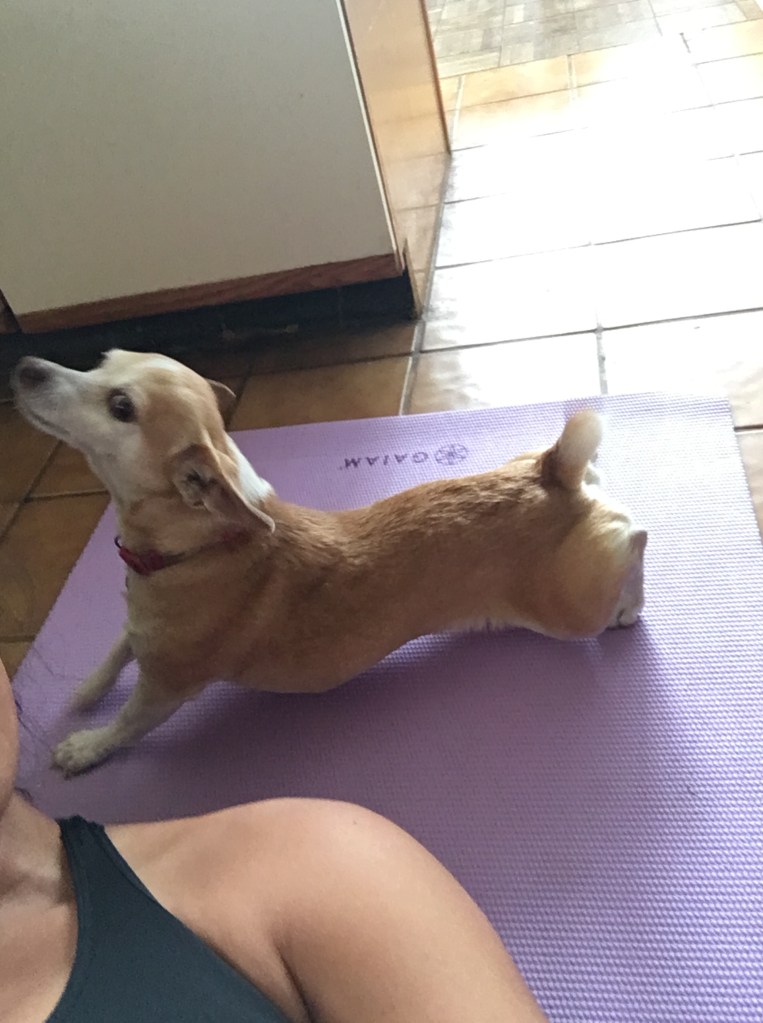
Only super fit people do yoga
If my chihuahua can dog yoga, so can you!
Yoga is a personal journey about realizing where you are at, and where you want to go from there. This sounds a little philosophical for my usual sarcastic tone, but completely true! It can be hard at time to not compare yourself to the people that literally look like they are floating off the mat next to you (and for me, I find it hard just not to stare), but in reality, everyone in a yoga studio is on a personal mission. I gauruntee the guy floating off of his mat a couple of feet away from me could care less if I do a perfect vinyasa or if my hips are in perfect alignment. You just need to be cool with the space you’re in!
Thankfully, most people practice yoga for the exercise benefits, meaning you’re not alone if you are feeling like you’re #struggling on your mat. Although many report starting yoga for exercise and stress relief, according to Dr. Park’s 2016 analysis in the Journal of Health Psychology, many practitioners shift their goals to other benefits including:
- relaxation
- pain relief
- weight control
- flexibility
- spirituality
- anxiety relief
Anyone can do yoga, and with this, anyone can benefit from it. The American College of Sports Medicine (ACSM) recommends individuals to participate in at least 2 to 3 sessions per week of balance and neuromotor (balance, coordination, etc) exercise lasting at least 20 minutes per session. Although neuromotor skills can easily be added into traditional resistance routines such as using a BOSU ball or doing unilateral exercises (ex. single leg squat), most people aren’t meeting flexibility recommendations. Flexibility may not be very crucial to what you think your needs are on a daily basis, however, reduced flexibility can lead to long term injury and difficulties with posture. So why not spend 20 minutes a day laying down and getting some stretching in?
Yoga is too expensive
Yeah, some studios are expensive. Sometimes I research studio websites and make sure there is no typo because there’s no way yoga can be that expensive.
It sucks that some really cool looking studios are expensive, but these also tend to be the ones with the most ammenities. They may have spa like locker rooms with free hand outs along the walls and hot tubs and saunas and the best instructors in town, but do you really need all of that if you’re just doing beginner yoga classes?
The cool fancy studios in town can be very expensive, but they also usually have good beginner deals to entice new clients. I just finished my 4 weeks for 40$ of classes at a studio and totally took advantage of it! I went to 10 classes, making it only $4 a class, and they gave me a special reduced membership offer once my 4 weeks had finished. This can be a great way to sneak yourself into some amazing yoga for an amazing price.
D
DISCLAIMER: Yoga deals can be such a steal, but, read the fine print. Some studios have very lenient policies in regards to introductory offers and you can walk away at any point without paying for a membership. Other studios may have you sign a contract, enter your payment information, and honestly, might feel kind of like a cult. Don’t get yourself stuck into a studio you’re not totally in love with! If they’re a good and reputable studio, they won’t need to get you stuck in some contract to make a quick buck.
Reputable yoga instructors also teach at community centers and colleges in your area. Recreation centers and facilities such as the YMCA offer reduced price or FREE classes for members, and often you can bring guests for free/a low price. Although these facilities likely won’t offer specialities such as hot yoga or aerial yoga, they do usually offer plenty of beginner classes along with the intermediate and advanced classes you would find at more traditional studios.
Don’t be afraid to look for new yoga options! Many yoga teachers do creative classes on their own based on client needs and you can find some really cool classes in your area. In my neighborhood in San Diego, yoga on the cliffs is commonly offered. For a low donation cost, you get to do a fun flow in an inspiring location– how cool is that?

You’ll get heat stroke!
This one’s kind of scary. When beginning hot yoga, especially more difficult hot yoga classes, you might feel like passing out. More than once.
But it goes uphill from there! I’ve defenitely felt like passing out a couple of times during my hot yoga classes, but 1. I never did and 2. I’ve never seen anyone else pass out either. I’m not saying it doesn’t happen, but it’s not as likely to happen as you would think.
Studio instructors and staff are trained and experienced to assist with any hot yoga related complications participants may face. They also encourage hydration before, during, and after class to make up for all you sweat. Typically instructors will also recommend eating between 1-3 hours before class as well to keep you at your best!
But we wouldn’t be going through all this pain if there were no gains, right?
Hot yoga should make you feel good, great even!
But aside from feeling good, you reap different benefits than you would in a traditional yoga class.
In a 2015 study led by Hannah Campbell of Jacksonville University, thermoneutral (non heated) yoga classes and a heated yoga class were put to the test to see what real benefits hot yoga has. In this study, they found participants had significantly higher heart rates while doing the same moves as participants in the non heated class. With this, they also had higher sweat rates, 51% more (it doesn’t take a genius to imagine that people in hot yoga would sweat more, but now you scientifically know they do), so if you love a good sweat, more power to you! After this sweat, participants in hot yoga classes were found to be more exhausted and were found to be more revitalized. In exchange, participants in the non heated yoga class were found to be increasingly tranquil after their flow. Non heated yoga class participants also had a 10% increase in flexibility after the class which was surprisingly more than the heated class participants.
So even though the unheated class participants had increased flexibility, both heated an unheated yoga will benefit you! All participants in the study left in a better mood than they were when they started their classes. And hopefully, so will you!
After you stop reading this article,
and go do yoga
on the cliffs
or with your dog
or maybe in a studio!
 chillfit