
Hi guys, thanks for tuning into my Zero to hero series! I just finished my finals for the semester and am excited to destress this holiday season with some long runs and spending time in the sun! In this post, I will give you the low down on my first pre-season as a cross country runner and what it was like for me, a non-runner, at the time. If you missed my first post, catch up with me here!
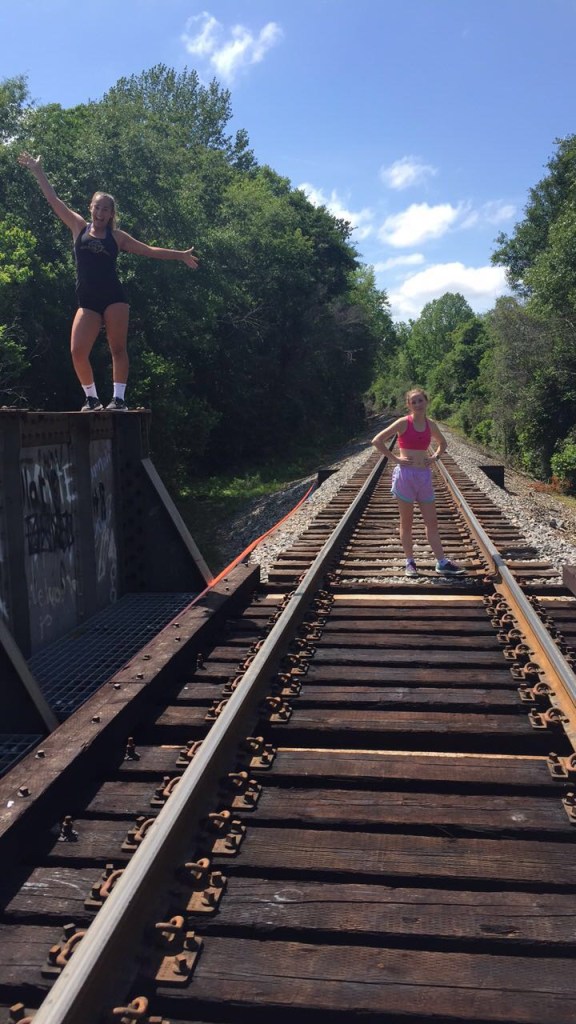
Where to begin?
Just watching a new sport is confusing. Take rugby for example. If you’re a football fan and decide to go to a rugby game, you’re going to be confused when the players are lifting each other up and throwing the ball in different directions.
If you think watching the game was confusing, picture playing in it.
That’s what I was doing my first season of college cross country.
I was a beach volleyball player. I had no technique or plan for my running. I’d never been to a cross country meet, and in just a few short months, I would be running against NCAA Division I and II opponents.
Talk about a trip.
But before my first race in the fall, I went through three months of off season conditioning. Now, this wasn’t your football team camp in the summer type of conditioning, this was “coach sends me an email with workouts and I try to do everything in it on my own” type of conditioning.
And it was hard!
In volleyball, you could hide lack of fitness. Obviously being fit is helpful, but some players are able to succeed without being superior athletes. Especially in indoor volleyball, where you have a small amount of court you’re responsible for, you can get away with being a little out of shape.
You can’t be out of shape and be successful as a distance runner. You will not be able to run your best after a night out and skipping the past two week’s workouts. You just can’t.
The science behind it
Success as a runner is determined in speed in the form of the race (you’re probably thinking “duh, I know what a race is), which can be explained greatly by one’s VO2 Max. One’s VO2 is the amount of oxygen they intake during a certain intensity of exercise. When one is at their VO2 Max, they are consuming the maximum amount of oxygen they can during intense exercise. These values are so important because consuming more oxygen means being able to function at higher intensities, therefore being a good indicator of cardiovascular fitness.
VO2 calculations can be a huge advantage to one’s training program, allowing one to calculate speeds and grades they should be running at during each point of training.
To calculate training speed, one must first calculate their VO2 reserve:
VO2Reserve=(intensity(VO2max-resting)+resting
note: resting VO2 is always 3.5ml/kg/min
Once this is found, VO2 reserve can be plugged into the equation to find speeds and grades that should be the focus of your workout. Because my VO2 max, at the time, was most likely much lower than it is now, the speeds and grades I could work out at were lower than they are now.
VO2 Reserve =.2(speed)+.9(speed)(grade)+3.5
Now why is this math important to my training? When training, you increase variables such as frequency, intensity, time, and volume (Does FITT-VP ring a bell to anyone?), and it needs to be measured accurately (if you want to gain in your athletic performance). Because my workouts consisted of intensity ranges and times for each days workout, and figuring out what range ranges I was at for each workout was difficult. Especially without a tech watch.
Below is an example of the first half of one of my workout “phases”(phases are actually a standard term for big aspects of training such as “the predatory phase” “transition phase” “in season,” etc) sent to me.
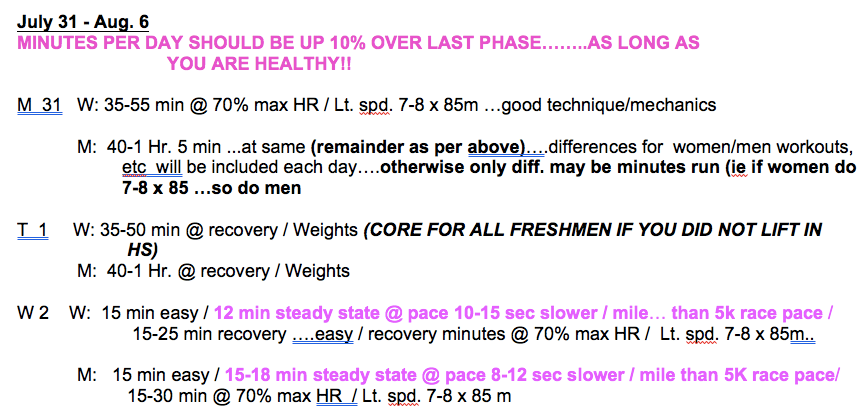
Luckily intensities measured for my workouts were based off of heart rate, which is much easier and quicker to measure than VO2 (as I never did an actual VO2 Max test during my college athletic career), although sometimes not as accurate. If you have some cool technology on your wrist like a FitBit or a Garmin Forerunner, this data is always available!
Although these workouts are completely manageable to me now (two years later), at the time, I wasn’t physiologically adapted to consistent long runs and struggled to keep up. I would love to see a comparison of my current VO2 max then and now, as it takes a decent amount of time for different body systems to adapt to running.
Blame it on the altitude
There was one more thing that made it difficult to see improvements in my speed.
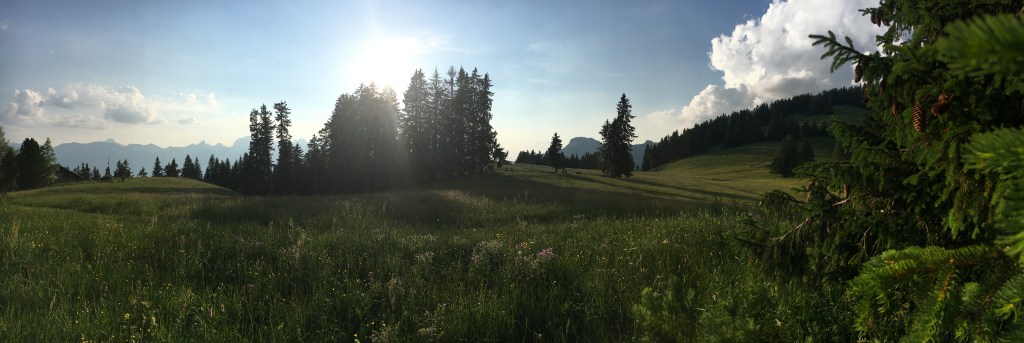
I was living in the Swiss Alps.

Yes, the same summer I walked onto an NCAA Cross Country team also happened to be the same one that I accepted a job in the Swiss Alps. What a coincidence right? Welcome to my life! So during the course of three months, I lived and worked in a small village with altitudes ranging from 4,000-6,000 ft.
Just a little bit different than what I was used to in the South.
Although this made running more challenging, I believe this mix of altitude training and hill training (you couldn’t get very far in the village without an incline) was my key for success as a runner. Putting myself against rougher conditions significantly improved my physical fitness and gave me an edge a lot of my teammates wouldn’t have. So, although I might have been struggling to do the workouts I was assigned, but I completed them at altitude with rolling hills. No one else on my team was training in the mountains, and no one else on the team had never done a real cross country workout before.
Wrapping it all up
I stayed true to my training schedule the best I could, enjoyed my time running through the beautiful Alps, and began to feel like a runner. Although I knew I was slow in this pre-season, the thought of being a part of such a fun and dynamic team was enough to get me through the summer (not to mention, I was afraid of throwing up on the first day of practice). I may not have been the fastest in the bunch, but I showed up everyday, gave it my all, and did my best to prepare myself for my first season. I didn’t know it at the time, but I had a different level of commitment, and it was apparent day one of the cross country season that fall.
Thanks for following along with my Zero to Hero Series! In my next post, I will cover the beginning of the cross country season, what went right, what went wrong, and how my school’s “Macaroni Mondays” effected my success. Let me know if there are any special topics you want me to capture, and I look forward to hearing from y’all!
 chillfit
1 thought on “Zero to hero: Go time”